
Action State Launches EvidenceBook to Make AI Agent Work Independently Checkable
Open-source evidence infrastructure, Terms Packs and Countersign help people and businesses establish what agents did
Press Release Disclaimer: This is a press release distributed through the XPR Media network. It has not been independently verified by our newsroom.

Open-source evidence infrastructure, Terms Packs and Countersign help people and businesses establish what agents did and whether the work met expectations.
SAN JOSE, CA, UNITED STATES, October 22, 2026 /EINPresswire.com/ — Action State Group (Action State) today announced at AGNTCon + MCPCon North America an open evidence layer for AI agents. EvidenceBook, open source under Apache-2.0, lets an agent keep a tamper-evident record of what it did and agreed, checkable by anyone without trusting its operator. Terms Packs define the requirements used to assess agent work. Action State Countersign, available today, adds an independently operated second signature. The layer is free, with open specification drafts underneath, so anyone can produce compatible evidence, define requirements and verify records. Action State’s products are built on top; because Countersign draws on the same open specifications and IETF building blocks, others can offer compatible services.
Given a goal, an AI agent can choose vendors, share information, negotiate, buy and delegate. People and businesses need to know the job got done, but also how, and whether it matched intent and expectations. Across organizational boundaries, a buyer, seller or provider should not have to rely solely on the performing agent’s account.
“As AI agents take on more work and begin doing business with each other, we need a common way to understand what they did and whether they delivered what was expected,” said Steven Mih, founder and CEO of Action State. “Evidence should be portable, free to verify, and owned by those relying on it, so we’re building it in the open.”
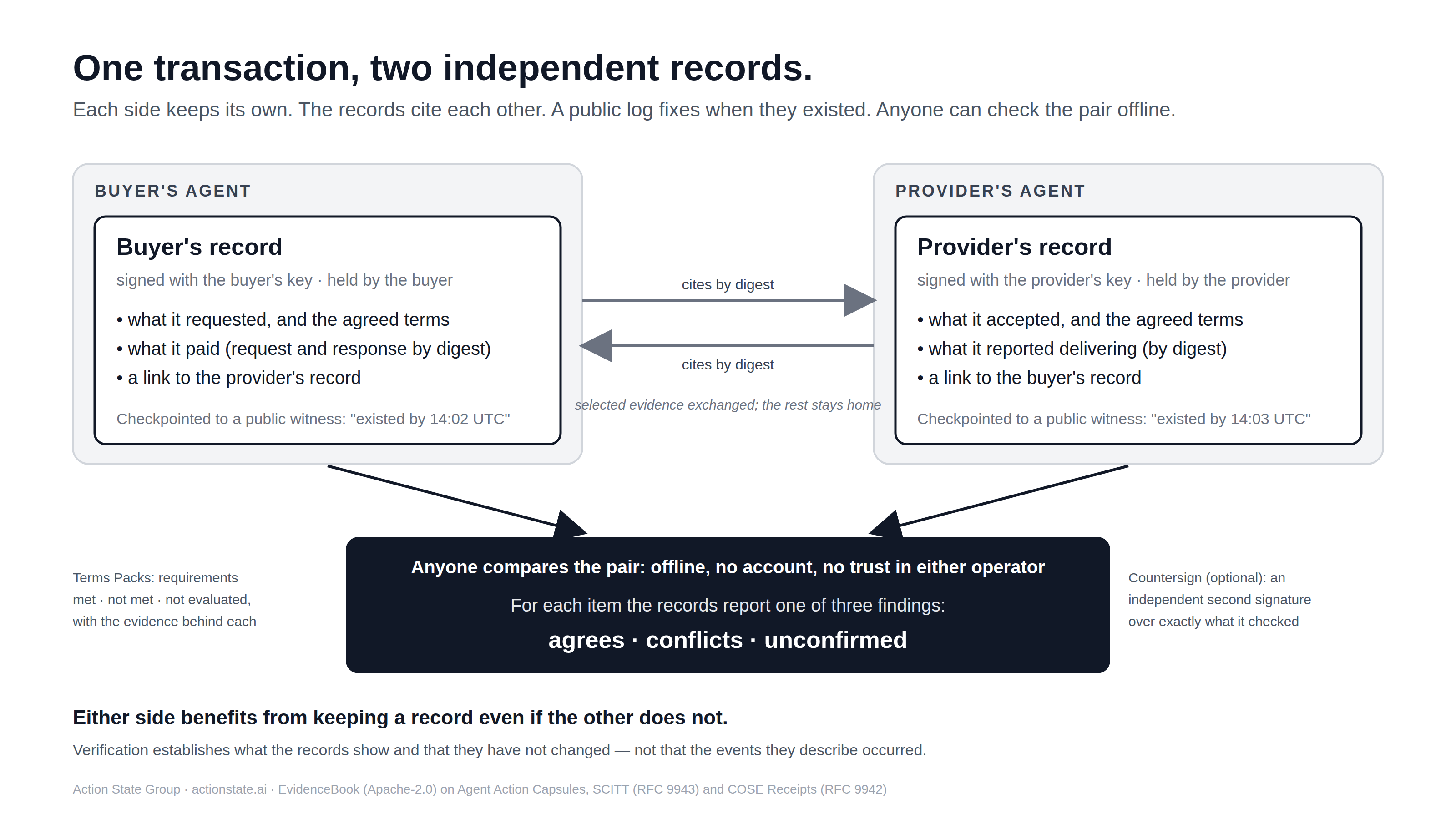
One transaction, two independent records
One company’s AI agent hires another company’s AI agent to do a job. They agree on the work, the price and what counts as delivery. Then each side keeps its own tamper-evident record. The buyer records what it requested and paid. The provider records what it accepted and reported delivering. The two can later exchange selected evidence and see what agrees, what conflicts and what remains unconfirmed. Either side benefits from keeping a record even if the other does not.
EvidenceBook uses Agent Action Capsules, the open record format at agentactioncapsule.org, and commits signed records to a tamper-evident history independent software can verify. It ships as open-source libraries with A2A and MCP bindings, so it runs inside an existing agent harness or runtime. A free public witness shows that a checkpoint existed by a particular time. Participants compare cryptographic references while keeping control of their data, disclosing more only when an outcome must be evaluated. Verification establishes what the records show and that they have not changed, not that the events they describe occurred.
“Agents are starting to act on behalf of people and interact with each other across companies and platforms,” said Mazin Gilbert, Executive Director of the Agentic AI Foundation. “For that to work, we need a way to independently verify what agents are doing, regardless of who operates them or which systems they use. An open, vendor-neutral evidence layer is a critical piece of that puzzle, and exactly the kind of work AAIF exists to support.”
Terms Packs and Countersign
Some requirements are easy to check: the agent disclosed it was an AI. Others are not: it did not pressure the customer, it negotiated fairly, it resolved the case without losing the relationship. A Terms Pack is a versioned list of such requirements, run over the records in the book, and every row is one of two kinds. A recomputed row is a fact or rule over the record, so anyone who runs it gets the same answer. A judged row is one where a judge decides the word — an AI model pinned to a version, or a named person — and the verdict records which. The judging steps ship as skills, instructions an agent follows, so how a verdict was reached is itself readable, and a human expert can take the judge’s seat where the stakes warrant it.
Results show which requirements were met, not met or could not be evaluated, with the evidence behind each finding, and the evaluation itself is sealed as a signed record. The same libraries apply a Terms Pack; the host decides whether an action proceeds. Public today: EU AI Act Obligations Pack and a draft Outcomes Pack for contracted work. Everyday Rules, for personal AI agents, ships with the Muse integration, adding to the platform’s own safeguards, and evaluates an action before it happens: allowed, not allowed, needs your approval, or not fully checked. Packs do not certify compliance or score trust; anyone can publish one.
Either side can already verify the other’s records; the software is free and the proofs travel with the evidence. But a party’s own verification is still its own word, and in a dispute both parties have an interest. Countersign, available today at countersign.actionstate.ai, runs the checks as a party independent of both sides: it recomputes specified cryptographic and structural checks over an evidence bundle, signs exactly what it checked and found, and records the result in its own transparency log. The finding therefore carries to an auditor, an insurer or a court that was not there. It does not certify that all actions were captured or that claimed outcomes occurred. Countersign is free while the first businesses that rely on it come on board.
Early examples
Mesh-LLM is an open-source distributed inference network. Action State brings portable, independently verifiable evidence to participating nodes, with no central evidence authority. Nodes verify their own records and, when both opt in, exchange evidence to compare what each observed.
“Our goal is to help Mesh-LLM nodes collaborate with peers they’ve never met,” said Michael Neale, creator of Mesh-LLM and Principal Engineer at Spiral/Block. “With the capsules plugin, each node keeps its own signed record, and participating peers can compare evidence. It is important that people consuming peer to peer inference are able to choose the level of trust for their sensitive workloads or agent consumption.”
With Project NANDA, agents discovered through the NANDA Index closed transactions with agents from an independent registry in a live deal room built on Agent Action Capsules. Each negotiation produced a sealed bilateral record both agents hold, complementing each side’s own account; the integration merged into the NANDAtown codebase in July 2026.
“Discovery tells you an agent exists. It cannot tell you what that agent did after you trusted it,” said Ramesh Raskar, Founder, Project NANDA. “Watching agents from two different registries close deals and walk away with the same cryptographic record, one that either side can prove to a stranger, was the missing half of the open agent economy running live.”
At his conference session Mih will show Muse agents buying and selling on the NANDA Index, each action checked against the rules its owner set.
Open standards and availability
The specifications are individual IETF Internet-Drafts with conformance vectors, not working-group documents, and build on two published IETF standards, SCITT (RFC 9943) and COSE Receipts (RFC 9942). Action State, a Silver Member of the Agentic AI Foundation (AAIF), plans to propose them for neutral foundation governance; membership does not constitute acceptance of the proposed projects. Mih presents “Who, May, Did” October 22, 4:40 p.m. PDT, Room 230C.
Availability: Open source and specifications at agentactioncapsule.org and on Action State GitHub repos. Products at actionstate.ai. Feature coverage varies by integration.
About Action State Group
Action State Group builds open, portable evidence infrastructure for the Internet of Agents. Mih previously co-founded Ahana, acquired by IBM in 2023. More at actionstate.ai.
Steven Mih
Action State Group
press@actionstate.ai
Legal Disclaimer:
EIN Presswire provides this news content “as is” without warranty of any kind. We do not accept any responsibility or liability
for the accuracy, content, images, videos, licenses, completeness, legality, or reliability of the information contained in this
article. If you have any complaints or copyright issues related to this article, kindly contact the author above.

Media gallery
