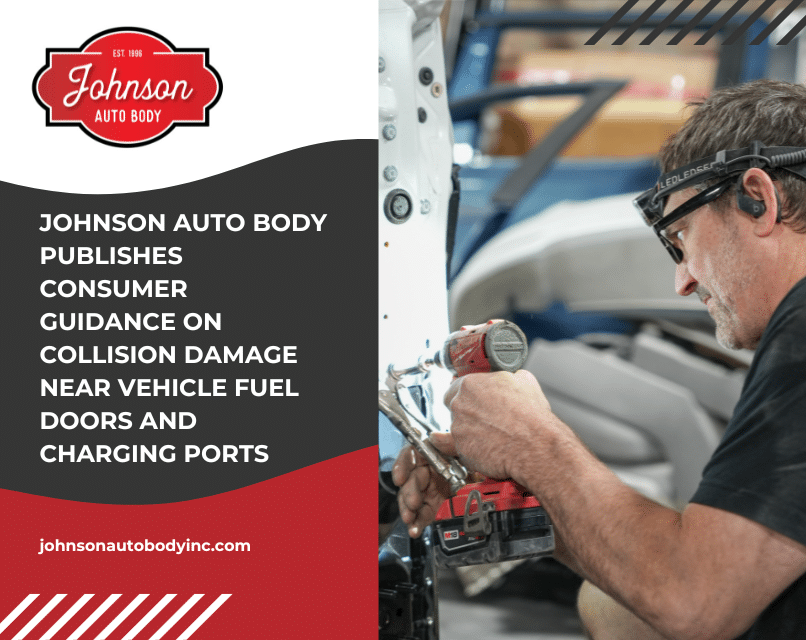
Johnson Auto Body Publishes Consumer Guidance on Collision Damage Near Vehicle Fuel Doors and Charging Ports
Knightdale, NC - October 14, 2026 - PRESSADVANTAGE - Johnson Auto Body has published new consumer guidance explaining
Press Release Disclaimer: This is a press release distributed through the XPR Media network. It has not been independently verified by our newsroom.

Knightdale, NC – October 14, 2026 – PRESSADVANTAGE –
Johnson Auto Body has published new consumer guidance explaining how collision damage near a vehicle’s fuel-filler opening or electric-vehicle charging port can involve more than the exterior door or surrounding paint. The October resource focuses on how the location of an impact can affect the evaluation and repair planning for nearby body panels, mounting areas, and vehicle-specific components.
The guidance expands on Johnson Auto Body’s collision repair information by addressing two exterior openings that can contain or sit next to components extending behind the visible body surface. The resource emphasizes that repair requirements depend on the individual vehicle, impact location, documented damage, and applicable manufacturer information.
On gasoline-powered vehicles, the fuel door is typically positioned within or adjacent to an exterior body panel. A collision near this area can affect the visible door or surrounding panel, but evaluation may also involve accessible mounting areas and components located behind the opening.
The October guidance distinguishes visible cosmetic damage from conditions that may require additional inspection. A dent or scrape near the fuel door does not by itself establish damage to components behind the panel. Likewise, an exterior opening that appears relatively undamaged does not provide enough information to determine the condition of concealed areas following an impact.
Johnson Auto Body’s auto body repair information provides additional context about how exterior panel damage can be evaluated for repair or replacement.
Electric vehicles introduce a related consideration because a charging-port opening can incorporate components and connections specific to the vehicle. The charging-port location and construction vary among manufacturers and models, so collision evaluation in this area cannot be based on a single procedure applied to every EV.
When collision damage occurs near a charging opening, repair planning can account for the visible body damage and identify the vehicle-specific information relevant to components located in the affected area. The appropriate inspection, disassembly, repair, or replacement operations depend on the vehicle and the conditions documented during the repair process.
The guidance does not suggest that every impact near a fuel door or charging port causes concealed component damage. Instead, it explains why the location of the collision matters when technicians determine which areas require evaluation.
Three factors provide the framework for the October resource: the location and direction of the impact, the condition of the surrounding body panel and opening, and the vehicle-specific components associated with that area.
Impact location helps establish which portion of the body received collision forces. The condition of the surrounding panel provides information about visible deformation, alignment, or surface damage. Vehicle-specific information then helps identify components and procedures relevant to the affected area.
This framework is particularly useful because fuel and charging openings are integrated differently across vehicles. Their doors, housings, mounting arrangements, surrounding panels, and associated components can vary in design. Repair planning therefore requires identification of the specific vehicle rather than assumptions based solely on the appearance of the exterior opening.
The October publication also addresses why disassembly may sometimes become part of the evaluation. Exterior body panels or trim can limit visibility of areas behind an opening. When the developed repair plan and applicable procedures require additional access, selected components may need to be removed so the relevant area can be evaluated or repaired.
Any such operation remains dependent on the vehicle and documented collision conditions. The presence of damage near a charging port, for example, does not automatically establish a problem with the charging system, just as damage near a fuel door does not automatically establish damage to the fuel system.
This distinction is central to the consumer guidance. The location of visible collision damage identifies an area that may require closer evaluation, but the repair plan is based on what is actually documented and the procedures applicable to the specific vehicle.
The resource also provides context for repair documentation that includes operations beyond correcting the most obvious dent or paint damage. When nearby components require access, inspection, removal, or other handling under the applicable repair procedure, those operations can become part of the developed repair plan.
Johnson Auto Body provides information about its facility and repair services through its Knightdale location resource.
The October guidance gives consumers a more focused way to understand collision damage around fuel and charging openings. Rather than assuming that every nearby component is damaged or treating the issue as purely cosmetic, the resource explains how impact location, documented conditions, vehicle construction, and applicable repair information guide the evaluation.
Johnson Auto Body is a locally owned collision repair business founded in 1996. The company provides collision repair and auto body repair services for Knightdale, Raleigh, Wendell, and surrounding Wake County communities. Its facility is located at 821 H & R Drive, Knightdale, NC 27545.
###
For more information about Johnson Auto Body Inc, contact the company here:
Johnson Auto Body Inc
Todd McGee
(919) 217-2887
todd@johnsonautobodyinc.com
821 H and R Dr, Knightdale, NC 27545