National Survey Asks Mediators Where AI Helps, Where It Creates Risk and What Comes Next
Mediate Lawsuit launches 2026 study examining AI use, confidentiality concerns, professional standards and changing
Press Release Disclaimer: This is a press release distributed through the XPR Media network. It has not been independently verified by our newsroom.
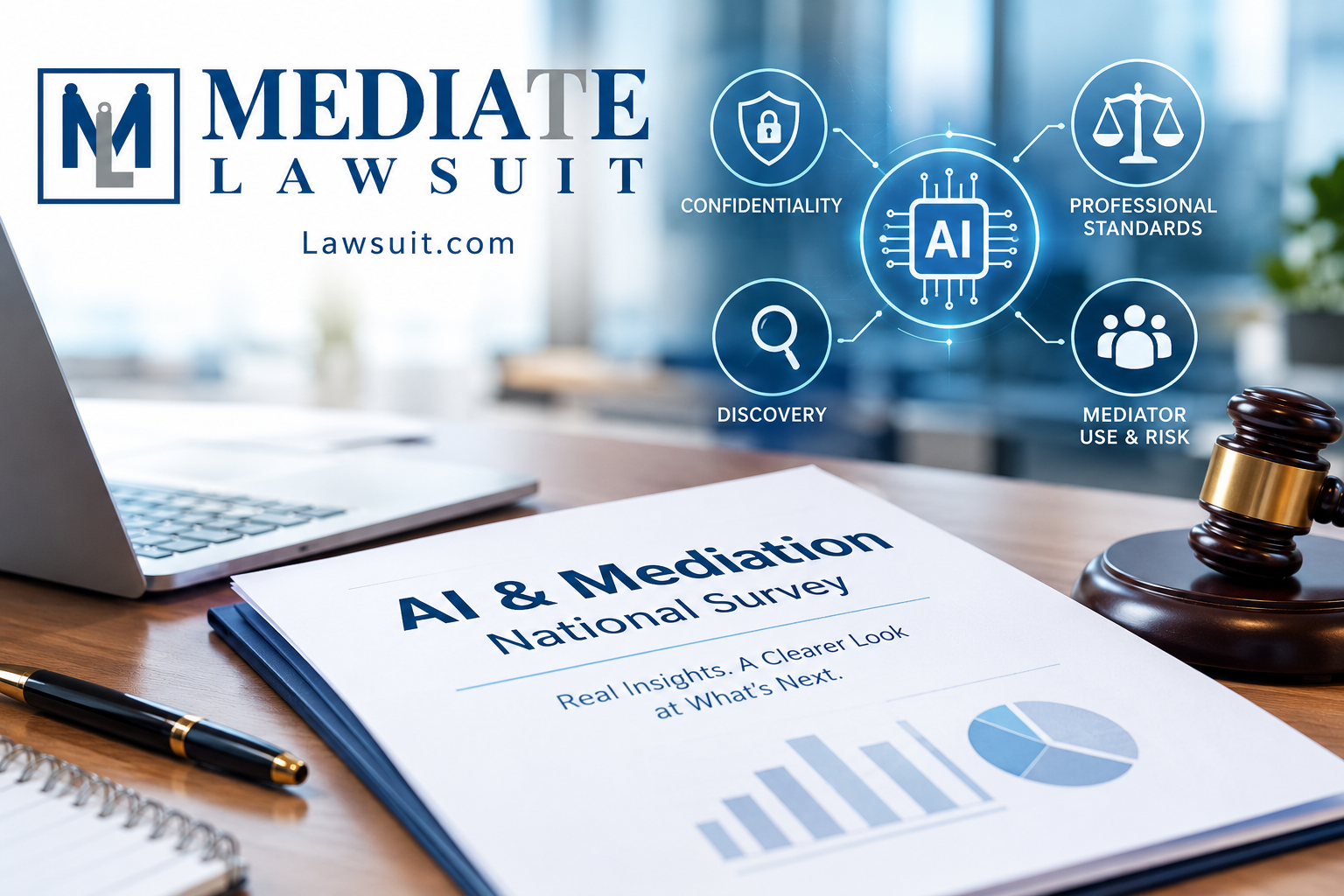

Mediate Lawsuit launches 2026 study examining AI use, confidentiality concerns, professional standards and changing mediator discovery across the United States
FORT LAUDERDALE, FL, UNITED STATES, October 12, 2026 /EINPresswire.com/ — As artificial intelligence becomes increasingly relevant to professional services, mediators face questions that go well beyond whether to use ChatGPT or another AI platform.
How are mediators actually using generative AI in their professional work? What concerns do they have about confidentiality, privacy and accuracy? Does the profession need clearer guidance for AI use? And will AI change how attorneys and clients find and evaluate mediators?
Those are among the questions behind the 2026 National AI & Mediation Survey, launched today by Mediate Lawsuit, the mediation and alternative dispute resolution platform powered by Lawsuit.com.
The national study aims to establish a benchmark for how practicing U.S. mediators use and evaluate artificial intelligence as the technology becomes more prominent in professional research, communication, and discovery.
“Artificial intelligence is raising practical questions throughout the mediation profession, but the people best positioned to tell us what is actually happening are mediators themselves,” said Bob Levin, Co-Founder and Chief Technology Officer of Mediate Lawsuit. “We want to document what mediators are doing with AI today, what concerns them and where they believe the profession is heading.”
AI Adoption Meets Questions of Confidentiality and Professional Responsibility
The survey examines AI adoption across the profession, including mediators who regularly use generative AI, those who use it occasionally or have experimented with it, and those who have not incorporated AI into their professional work.
Participants are asked about uses such as professional research, document summarization, drafting and editing correspondence, preparing mediation-related materials, administrative work, and marketing and business development.
The study also examines issues that carry particular significance in mediation, including confidentiality of mediation information, data privacy and security, accuracy of AI-generated information, fabricated information or citations, professional responsibility, potential bias, over-reliance on technology and loss of the human element in mediation.
Participants are also asked whether the mediation profession needs clearer professional guidance or standards regarding the use of generative AI.
“Mediation depends heavily on confidentiality, professional judgment and human interaction,” Levin said. “This study is designed to examine where mediators believe AI can add value, where they see risk and where the profession may need clearer guidance.”
AI May Also Change How Mediators Are Found
The research extends beyond how mediators use AI in their own work.
The survey asks mediators whether they have searched for themselves or their practices on AI platforms, how important they expect AI to become in helping attorneys, businesses and consumers identify or evaluate mediators, and whether their practices have taken steps intended to improve how their professional expertise is represented or discovered by AI systems.
This portion of the research examines whether artificial intelligence may influence not only the practice of mediation, but also how mediation professionals are researched and selected.
Six to Seven Minutes to Contribute to a National Benchmark
The 22-question survey takes approximately six to seven minutes to complete and is open to practicing mediators throughout the United States.
Participants will have access to the survey results, giving them an opportunity to compare their approach to AI with the practices, concerns, and expectations reported across the mediation profession.
Mediate Lawsuit plans to analyze responses in aggregate and publish the findings after the study concludes. The resulting report will examine AI adoption, professional concerns, and mediators’ expectations about the technology’s role in the profession.
Participation is voluntary. Individual responses or comments will not be publicly attributed to respondents without their permission.
The 2026 National AI & Mediation Survey opens October 15, 2026, and will accept responses through November 15, 2026.
Take the 2026 National AI & Mediation Survey
Practicing U.S. mediators can participate and learn more at:
2026 National AI & Mediation Survey
About Mediate Lawsuit
Mediate Lawsuit, powered by Lawsuit.com, provides resources connecting attorneys, businesses, and consumers with mediation and alternative dispute resolution professionals. Through Lawsuit.com, the organization also publishes educational content examining mediation, ADR, artificial intelligence, legal technology, and digital discovery.
Bob Levin | Co-Founder & Chief Technology Officer
Mediate Lawsuit / Lawsuit.com
+1 561-289-1878
Visit us on social media:
LinkedIn
Instagram
Facebook
YouTube
X
Legal Disclaimer:
EIN Presswire provides this news content “as is” without warranty of any kind. We do not accept any responsibility or liability
for the accuracy, content, images, videos, licenses, completeness, legality, or reliability of the information contained in this
article. If you have any complaints or copyright issues related to this article, kindly contact the author above.

Media gallery