
Global Leaders Convene During UN General Assembly Week to Advance Equitable Access to Life-Saving Mechanical Thrombectomy and Acute Stroke Care
NEW YORK, Oct. 8, 2026
Press Release Disclaimer: This is a press release distributed through the XPR Media network. It has not been independently verified by our newsroom.

Global Leaders Convene During UN General Assembly Week to Advance Equitable Access to Life-Saving Mechanical Thrombectomy and Acute Stroke Care
PR Newswire
NEW YORK, Oct. 8, 2026
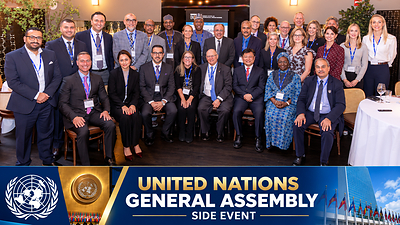
NEW YORK, Oct. 8, 2026 /PRNewswire/ — Government officials, global health leaders, clinicians, patient advocates, professional societies, and industry partners gathered during United Nations General Assembly week for “From Resolution to Action: Investing in Acute Stroke Care,” a convening focused on translating global commitments on stroke into concrete improvements in prevention, acute treatment, rehabilitation, and access to care. The September 22 reception was convened through the Society of Vascular and Interventional Neurology’s (SVIN) Mission Thrombectomy in partnership with the Business Council for International Understanding (BCIU), Philips, and Medtronic Neurovascular.
The event brought together representatives from leading international cardiovascular, stroke, neurointerventional, and global neurosurgical organizations, including the American Heart Association (AHA), World Stroke Organization (WSO), World Federation of Interventional and Therapeutic Neuroradiology (WFITN), Society of NeuroInterventional Surgery (SNIS), and International Society for Global Neurosurgery (ISGNS), alongside Ministries of Health and other global health stakeholders. Together, they brought perspectives spanning public health, stroke systems, neurointervention, global neurosurgery, policy, and implementation.
From Resolution to Action
The gathering came at a pivotal moment for global stroke policy. WHA79.10, adopted by the World Health Assembly in May 2026, represents a landmark global commitment to addressing stroke comprehensively, including prevention, acute care, rehabilitation, and health-system readiness.
Importantly, WHA79.10 was championed by the Egyptian Ministry of Health and Population, with support from the Global Stroke Action Coalition (GSAC), a coalition comprising global organizations and industry leaders dedicated to advancing stroke prevention, treatment, rehabilitation, and access to care worldwide. The resolution represents an important example of how governments, professional organizations, patient advocates, and industry can work together to elevate stroke on the global health agenda.
The discussion centered on a fundamental challenge: scientific advances have made highly effective stroke treatments possible, including mechanical thrombectomy for large-vessel occlusion, but millions of eligible patients worldwide still cannot access these treatments in time.
Strokenomics: Investing in Recovery
Dr. Fawaz Al-Mufti, Global Chair, SVIN-Mission Thrombectomy, opened the clinical discussion with “The Clinical and Economic Case for Acute Stroke Treatment,” highlighting the extraordinary effectiveness of mechanical thrombectomy for eligible patients with large-vessel occlusion stroke.
Drawing on global data and an economic analysis spanning six countries, Al-Mufti emphasized that investing in access to thrombectomy can represent a fraction of the societal cost associated with stroke-related disability.
“We are already paying for stroke,” said Al-Mufti. “The question is whether we choose to pay for recovery today or disability for years to come. A timely thrombectomy can offset a lifetime of disability and its associated costs. We need to stop viewing thrombectomy simply as a procedural expense and recognize access to effective stroke treatment as an investment in people, families and national capacity.”
A Riveting Story of Resilience: A Patient Puts a Human Face on the Numbers
The patient perspective was brought into sharp focus by Margaret O’Neil Wheeler, who shared a moving account of resilience and fortitude following a large-vessel-occlusion stroke. Accompanied by her husband, whose prompt recognition and action helped get her to life-saving care in time, Wheeler was reunited at the event with Dr. Fawaz Al-Mufti, who performed her emergency mechanical thrombectomy at Westchester Medical Center. Their reunion put a human face on the numbers, offering a powerful reminder of what timely access to advanced stroke care can mean: not simply survival, but recovery, independence, and the opportunity to return to life after stroke.
From Global Advocacy to Global Access
Dr. Dileep Yavagal, Founder and Global Chair Emeritus, SVIN-Mission Thrombectomy, followed with “From Global Advocacy to Global Action.”
Yavagal described stroke as a “long neglected pandemic” and emphasized that solving the global access gap requires more than simply building additional thrombectomy centers. Sustainable systems require public and pre-hospital education, government advocacy, technology, financing, trained teams, and implementation strategies tailored to individual countries.
“We have crossed the scientific frontier – we know thrombectomy can profoundly alter the course of a devastating stroke,” said Yavagal. “The frontier before us now is access.”
SVIN Leadership: Turning Recognition Into Action
The urgency expressed at the convening reflects a broader commitment from SVIN leadership to translate scientific progress and global policy recognition into measurable improvements in stroke care worldwide.
Santiago Ortega-Gutierrez, MD, President of the Society of Vascular and Interventional Neurology, framed this as a responsibility for SVIN and the broader stroke community:
“Stroke does not respect borders, and access to life-saving treatment should not be determined by where a patient lives. The science is clear, the therapies exist, and the global community has recognized stroke as an urgent health priority. Our responsibility now is to turn that recognition into action. Through Mission Thrombectomy, SVIN is committed to measurable progress in access, treatment, and recovery—with the goal that every eligible patient has a meaningful opportunity to survive stroke without preventable disability.”
Kaiz Asif, MD, Vice Chair of SVIN–Mission Thrombectomy, focused on the ultimate measure of that progress: whether treatment reaches patients:
“Recognition is important, but ultimately our success will be measured by access. Our goal is to translate this global momentum into a simple reality: that more patients, regardless of where they live, can reach life-saving thrombectomy in time.”
Robin Novakovic-White, MD, President-Elect of the Society of Vascular and Interventional Neurology, emphasized the collaboration required to translate scientific advances into equitable access:
“The science has given us the ability to dramatically change the outcome of a devastating stroke. The next challenge is ensuring that this opportunity is not defined by geography or resources. That will require sustained collaboration among clinicians, health systems, governments, and communities to translate what we know into meaningful access for patients worldwide.”
Building Systems That Make Recovery Possible
Industry partners underscored that innovation must be accompanied by the systems required to deliver treatment.
“Innovation alone is not enough. Devices and therapies make a meaningful difference only when patients can reach the right facility, receive timely diagnosis, and be treated by trained teams within an integrated system of care,” said Signe Haughton, Senior Director of Medical, Government, & Societal Affairs and Chief of Staff at Medtronic Neurovascular
Philips emphasized the role of connected technologies and workflows:
“For people experiencing stroke, every minute matters. Better-connected data, technologies, and clinical workflows can help healthcare professionals make timely decisions, support rapid diagnosis and appropriate treatment, and expand access to the right care when patients need it most,” said Felipe Basso, Chief Executive Officer, Latin America, Philips.
Egypt Demonstrates What Implementation Can Look Like
Dr. Mohamed Fawzi, Radiology Advisor to the Minister of Health and Population, Ministry of Health and Population, Arab Republic of Egypt, provided a country perspective on building a national stroke system.
Egypt’s progress includes 206 stroke units and centers, 58 certified through GAHAR, free thrombolysis, reimbursement for thrombectomy, approval of tenecteplase, and a prehospital hotline linking approximately 100 hospitals. A national electronic stroke registry is also being launched, with plans to expand the network to 440 units, strengthen certification, establish a national rehabilitation pathway, and publish national treatment rates and treatment times.
The message emerging from the convening was clear: a resolution creates momentum; implementation is what changes outcomes for patients.
The science exists. The therapies exist. The opportunity now is to build the systems that ensure every eligible patient – regardless of geography or resources – can reach life-saving stroke treatment in time.
 View original content to download multimedia:https://www.prnewswire.com/news-releases/global-leaders-convene-during-un-general-assembly-week-to-advance-equitable-access-to-life-saving-mechanical-thrombectomy-and-acute-stroke-care-302902415.html
SOURCE Society of Vascular and Interventional Neurology


